Building Moats in the AI Era - Part 4: The Innovation Stack
By
Virta Ventures
ON
February 4, 2026
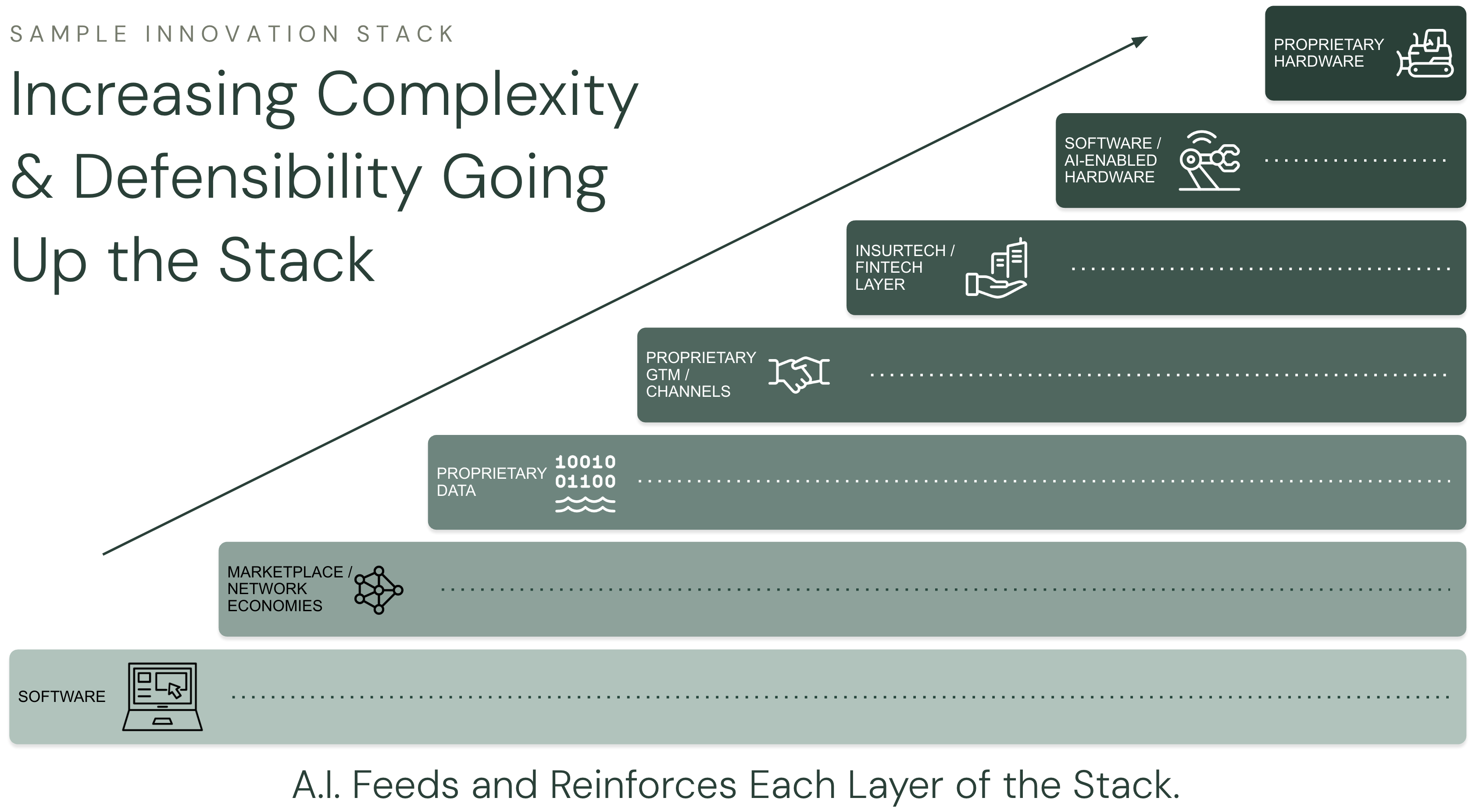
In Parts 1-3, we explored the individual sources of competitive advantage available to founders in the AI era: the 7 Powers, narrative command, distribution ownership, and compound startup structures. But the most defensible AI-native companies, as we’ve alluded to, aren’t building single moats. They’re building innovation stacks, integrated layers of reinforcing advantages that compound over time and become exponentially harder to replicate.
The concept comes from James McKelvey’s framework in The Innovation Stack. Pulling from his experience Co-Founding Square, McKelvey observes that category-defining companies build stacked layers of interlocking innovations, where each layer solves a new problem created by the previous one. Square started by solving payment acceptance for small merchants. That created a fraud problem, leading to proprietary risk models. Those models revealed a capital problem, leading to lending products. Each layer was born from the constraints of the last, making the whole system harder to copy.
In the AI era, the stakes and velocity have fundamentally changed.
Why Innovation Stacks Matter More in the AI Age
AI has democratized the building blocks of software. Open-source models, fine-tuning APIs, and off-the-shelf orchestration tools mean the first layer of innovation can be built and copied faster than ever. A thin wrapper around Claude or GPT-4 isn’t defensible alone. The same goes for a vertical copilot with no proprietary data.
This is the commoditization trap. Single moats erode faster than they ever have. But a company that stacks multiple reinforcing layers creates a system where removing any one piece weakens the entire structure.
Consider the gap between a feature and a flywheel: a resume-builder chatbot is a feature. Dozens of competitors will launch identical versions within months. But a recruiting platform that captures proprietary data on job placements, learns from hiring outcomes, embeds deeply into HR workflows, and owns the channel to both candidates and employers, that’s a stack. Remove the data and the AI gets worse. Remove the distribution and customer acquisition becomes expensive. Each layer depends on the others.
In the AI era, innovation stacks are survival.
Virta Portfolio Companies’ Innovation Stacks
Lumina: Hardware as the Foundation
Lumina is building fully electric construction equipment, starting with dozers. Over time, they are building a self-reinforcing innovation stack:
Layer 1: Proprietary Hardware & Counterpositioning. Lumina designed their own electric-powered dozers from the ground up, with custom battery management, motor control, and thermal systems. This is a Cornered Resource that competitors like Caterpillar can’t replicate without cannibalizing their diesel business.
Layer 2: Field Data Collection. Every deployed dozer generates real-world operational data: performance in different soil conditions, battery degradation patterns, operator behavior, failure modes. This data is proprietary and continuously refreshed, a living stream only Lumina can access, another Cornered Resource.
Layer 3: Fleet Learning and AI Improvement. That data powers continuous model improvement. The AI that predicts optimal blade angle, battery charging, or maintenance windows gets better with every machine deployed. Each new unit in the field makes the entire fleet smarter. This is Network Effects at the hardware level.
Layer 4: Manufacturing Scale Economies. As Lumina scales production, BOM costs fall and manufacturing processes improve. Lower costs per unit mean faster market expansion, which means more field data, which means better AI.
Layer 5: Counter-Positioning and Brand. Caterpillar and Komatsu face an innovator’s dilemma: investing in electric dozers cannibalizes their core business. Moreover, the incumbents make a lot of money from maintenance and parts replacement, while electric drivetrains lead to far less wear and tear. Lumina is starting fresh and has the opportunity to own the narrative around electric construction. Their brand becomes synonymous with the future of the industry.
Treehouse: Distribution Ownership as the Foundation
Treehouse, an AI-driven electrification services platform, has built an early go-to-market advantage, forged exclusive partnerships with auto retailers, fleet owners, and hardware OEMs. These partnerships provide zero-CAC customer access, a Cornered Resource competitors can’t easily replicate.
But the real moat is Process Power. Treehouse AI platform automates everything from quoting and contracting to permitting and scheduling - driving down costs, reducing time-to-install, and maximizing utilization. Managing and scaling teams of electricians while maintaining quality requires deep domain knowledge, cultural alignment, and complex systems all working in harmony.
The software becomes deeply integrated into partner operations. OEMs rely on Treehouse to efficiently quote customers and manage installers. Contractors rely on it to maximize utilization. Customers expect the service level it enables. Each stakeholder has Switching Costs, and collectively, they form organizational lock-in.
As Treehouse scales, it accumulates proprietary data on what works: the precise costs of countless designs, which contractors are most efficient, and more. This data feeds back into operations, making the system more efficient with each new partner and end customer. Competitors can’t simply build better software and win. The software is only valuable atop a foundation of exclusive distribution, operational know-how, and embedded switching costs.
Resilience Investments: Data and Operations Compounding + Counter-Positioning
Resilience is building climate-adjusted underwriting models to identify undervalued properties in more resilient geographies. Rather than sell their models and data to real estate developers, Resilience is using them as a Cornered Resource to build a new-age, resilience focused real estate platform.
Incumbent real estate platforms are concentrated in high-growth but climate-vulnerable regions, where insurance and maintenance costs are skyrocketing. They can’t pivot to resilient regions without signaling overexposure in their existing portfolios. Resilience Investments is starting fresh, counter-positioned, with no legacy constraints. They are staking out a market that incumbents can’t openly chase.
But Resilience isn’t just identifying better regions and properties, they are focused on reducing operating costs and improving the experience, with AI-powered systems for maintenance prediction, tenant management, and energy optimization. This operational discipline compounds their data advantage: better operations mean better returns, driving capital supply and tenant demand creating a virtuous flywheel.
Decision Moats / Context Graphs
Another emerging source of defensibility in AI-native stacks is decision traces, capturing not just what happened, but why it happened: approvals, exceptions, and reasoning that often live in Slack threads or people’s heads. The strongest moats come from being in the execution path: orchestration platforms that act at the point of decision see context in real time, recording inputs, policies, and exceptions as they happen. Startups like Actual and Everstar turn this tacit knowledge into structured, continuously refreshed data, creating a proprietary memory that compounds with every workflow. Integration isn’t just a switching cost, it’s a knowledge graph competitors cannot replicate, making automation smarter over time.
Building Your Stack
Creating an innovation stack isn’t about following a strict sequence. It’s about understanding which layers will reinforce each other and make your company hard to copy. Think of it as a toolkit for strategically layering defensibility.
1. Focus on Scarcity and Reinforcement
Every strong stack starts with a layer that is hard for competitors to replicate. This could be unique hardware (Lumina), exclusive distribution (Treehouse), proprietary data (Resilience), or deep operational know-how. The exact order depends on your market and your starting point. The key is that each new layer amplifies the previous ones, creating compounding advantages over time.
2. Design for Compounding, Not Just Speed
Speed is valuable, but only when it contributes to reinforcing your stack. Layers that compound over time—like learning from data, building operational flywheels, or strengthening network effects—are what differentiate a stack from a collection of features.
3. Integrate Operations, Technology, and Relationships
Stacks are rarely purely technological. Operational processes, partnerships, and customer relationships can form defensible layers just as powerful as proprietary algorithms or hardware. Look for areas where your system can continuously improve itself: where usage generates insights, insights improve operations, and operations strengthen the overall advantage.
4. Test and Adapt Dynamically
Markets change and AI evolves quickly. Treat your stack as a living system: test layers, measure how they reinforce each other, and adjust as needed. Some layers may need strengthening before the next can be added, while others may naturally emerge as your stack grows.
5. Think in Systems, Not Products
A stack is about integration. Data, AI, operations, distribution, and brand should interact so that removing one weakens the others. The strongest stacks create a self-reinforcing system where each piece adds value to the whole.
Ask Yourself the Core Questions
-Which PARTS of my company would be hardest for competitors to replicate?
-How can layers in the stack amplify each other?
-What can we build that grows stronger the more it’s used?
Answering these questions helps you focus on building layers that matter most, rather than features that can be copied in months.
Conclusion: From Features to Flywheel
We started this series asking: “How do you build lasting competitive advantages in the age of AI?”
The answer is surprisingly simple: AI doesn’t kill moats. It redistributes which ones matter and how fast you need to build them. Individual powers remain powerful only when stacked intentionally. Distribution ownership, narrative command, and compound structures matter only as layers in a larger system. Speed matters only as a process power that enables you to sequence your stack faster than competitors.
The companies defining the next decade won’t be those with the best initial product or those who just move fastest. They’ll be those who recognize that defensibility comes from building stacks: integrated, reinforcing layers of advantage that compound over time.
At Virta, we’re actively investing in founders building genuine innovation stacks. If you’re thinking about how to layer your advantages, sequence your moats, and turn speed into defensibility, we’d like to talk.
In the AI era, the companies that endure aren’t those with single advantages. They’re those with stacks.