Building Moats in the AI Era - Part 3: Beyond the 7 Powers
By
Virta Ventures
ON
December 3, 2025

At Virta Ventures, we are (clearly) massive fans of the 7 Powers framework. But in the age of AI, we view it as nearly, but not entirely complete. From the experiences of our portfolio companies, we see the most durable moats not simply emerging from product superiority or network effects alone. They arise from how founders structure their companies, command narratives, and own distribution from day one, concepts we believe function as stand alone moats.
Most founders build products, then figure out distribution. The most defensible companies are doing the inverse: using distribution, narrative, and structural decisions as moat-building tools from day one. We elaborate on each of these emerging powers—and what they entail for founders building in the AI era—below.
Narrative Command: Controlling the Discourse
Narrative Command occurs when a startup or company’s story becomes the story of an entire vertical. All discourse happens inside that frame, and competitors must spend extra capital just to be heard.
Tesla is the archetype. Waymo may have deployed robotaxis first, but “autonomous driving” = Tesla’s lane. Tesla controls how the category is understood, named, and discussed. “Full Self-Driving” is now the language everyone uses, and its Master Plans set the timeline all others are judged against.
Narrative Command has multiple components: forward-leaning vision that sets the terms of debate, seminal products that redefine expectations, default market language that genericizes terminology (“Google it”) in your favor, and often, a charismatic founder inseparable from the narrative.
Jimmy Douglas honed his skills in Narrative Command at Tesla. At Plug, he’s applying the same playbook to wholesale EV auctions, setting the terms for how EVs are valued, sold, and understood. Like Tesla, Plug produces seminal content and forward-looking roadmaps; unlike Tesla’s consumer messaging, Plug focuses on B2B economics—pricing structures, fleet-level adoption, and auction mechanics. His content floods conferences, LinkedIn, and industry publications, creating a frame where Plug defines the category.
The trap: Narrative Command without product-market fit is hollow. Tesla survived because reality validated the narrative. When narrative and reality diverge, the moat erodes. The discipline is building a story your product can eventually inhabit.
The lesson: Narrative Command works at any scale. Tesla proved it at consumer markets; Jimmy Douglas is proving it in wholesale EVs: the mechanism, leverage, and moat are the same.
Distribution Ownership: Building Defensibility Through Go-To-Market Structure
Most founders accept inherited distribution channels, relying on standard go-to-market playbooks or third-party intermediaries to reach customers. The defensible ones take direct control, designing distribution as a core strategic asset rather than a post-launch function.
Our portfolio company Treehouse simplifies electrification through software-enabled installation services. Instead of building software and hoping electricians adopt it, Treehouse forged exclusive partnerships with auto retailers, fleet owners, and hardware OEMs. These partnerships provide zero-CAC customer access: a cornered resource in and of itself.
The real moat, however, lies in Process Power and Switching Costs, which we detailed in Part II. Treehouse’s proprietary software is deeply integrated into partner operations, making removal operationally disruptive. Its AI-driven system optimizes contractor scheduling, utilization, and margins in ways traditional companies can’t match. Partner success drives customer success. Here, switching costs aren’t about technical lock-in; they’re about organizational embedding through performance and results.
This represents a lower-capital path to distribution ownership than acquisition, but it requires Process Power so strong that partners can’t imagine operating without you. Treehouse achieves this by acquiring key access points, embedding deeply within partner ecosystems, and structuring relationships so that distribution itself creates lock-in. They don’t just sell through channels; they architect them. This control transforms what is typically a cost center into a source of defensibility, one that compounds through data ownership, feedback loops, and integrated operations.
The Compound Startup: Structural Defensibility Through Breadth
Some of the most defensible companies aren’t building single products. They’re building platforms that combine multiple adjacent products, creating switching costs through breadth and controlling how those products reach and are used. Thalo Labs started with HVAC Copilot, a connected AI solution that gives real-time performance data and service guidance for refrigerant-based HVAC systems. The company has quickly expanded into a broader building operations platform.
Each adjacent product increases switching costs, while integrated data connects insights across operations. At the same time, the platform embeds deeply into customer workflows, giving Thalo control over adoption and usage—effectively owning distribution channels as part of its structural moat. In a recent luxury retail building in New York City, six Copilot devices provided 24/7 monitoring of rooftop units, flagging energy anomalies and system issues before they impacted comfort or margins. Customers adopting one Thalo product naturally adopt the others because the system becomes inseparable from their workflow. Early traction is evident, and as more products layer on, the platform compounds defensibility.
Distribution ownership contributes to defensibility in four ways. First, faster feedback loops let you see where your AI breaks in real-world conditions within hours, not months, and iteration speed compounds. Second, embedded systems generate unique, proprietary data that power continuous model improvement. Third, full integration means no compromise between what the AI can do and what customers actually need. Finally, owning distribution turns narrative into proof: you do not just tell the story, you show it.
This works when:
• Adjacent products expand the system rather than siloing it
• Each product is independently valuable
• Data integration strengthens insights and lock-in
• Capital efficiency through shared infrastructure
When Moats Reinforce Each Other
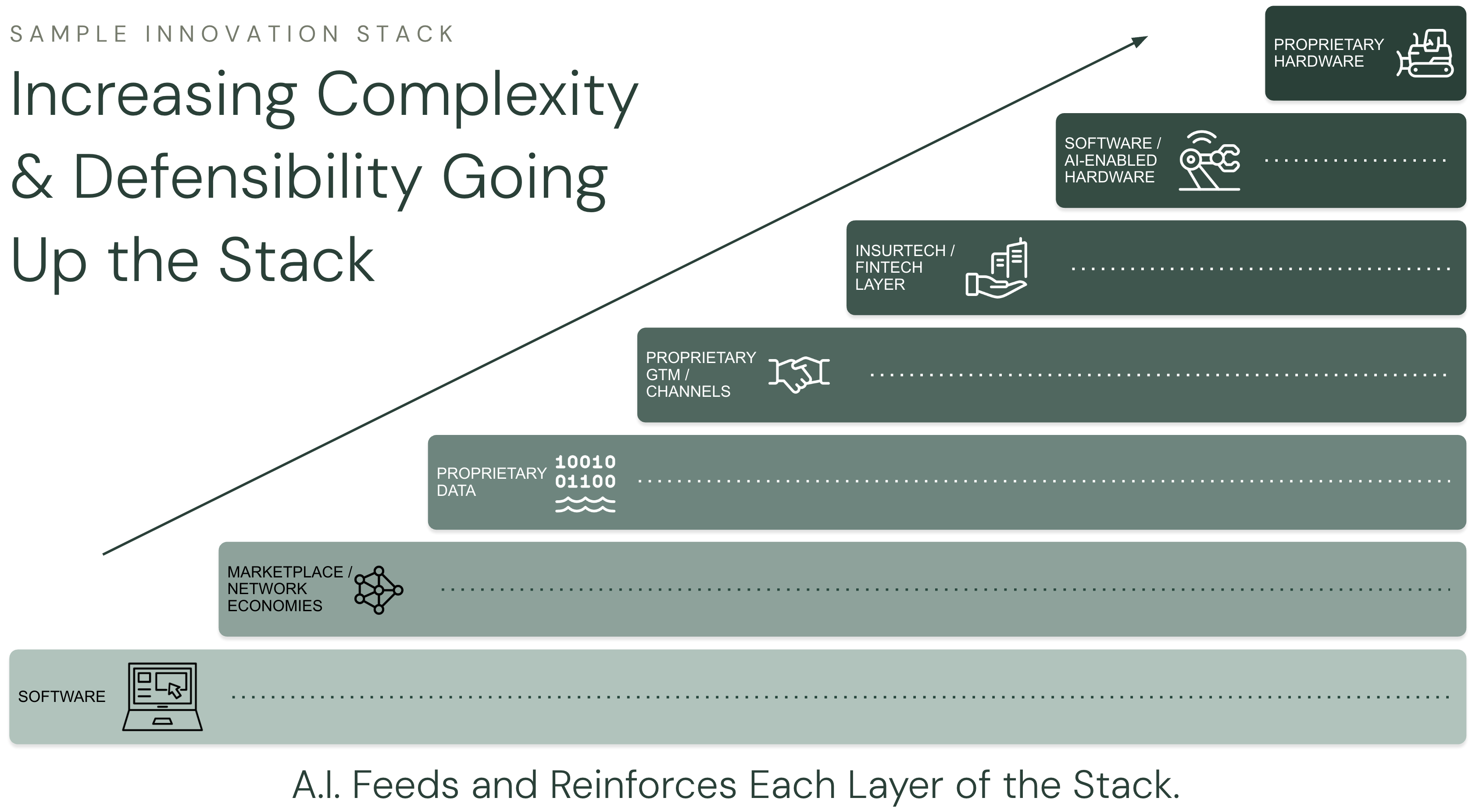
The pattern: the most defensible founders aren’t building single moats. They’re stacking layers of competitive advantage that reinforce what we call an “innovation stack,” (and will elaborate on in Pt. IV).
Tesla’s Stack: Forward-leaning vision (Narrative Command) → seminal products that redefine category (Brand Power) → proprietary manufacturing and battery tech (Cornered Resource) → operational data from fleet (Network Effects + Scale Economies) → competitors face cannibalization risk if they compete (Counter-Positioning). Remove any layer, the stack weakens. Together, nearly impossible to replicate.
Thalo Labs’ Stack: HVAC Copilot (Product-Market Fit) → expands into broader building operations platform (Compound Startup structure) → integrated data across products (Data network effects) → switching costs that single products can’t match (Switching Costs) → capital efficiency through shared infrastructure (Process Power).
Treehouse’s Stack: Exclusive partnerships (Cornered Resource) → AI-driven operations (Process Power) → deeply embedded in partner systems (Switching Costs) → one partner’s success drives adoption with similar partners (limited network effects).
What connects these all: intentionality. These founders aren’t building moats accidentally. They’re making deliberate structural choices about what to build, capital deployment, and sequencing so each layer reinforces others.
They understand: single moats are insufficient in the AI era. Speed (again) as a standalone erodes. Product advantage alone gets copied. Brand power takes too long. But layered, sequenced, reinforcing powers create defensibility that compounds and becomes increasingly difficult to attack.
Synthesis
In sum, the companies building enduring defensibility are combining three structural advantages:
- Narrative Command → easier to own distribution channels and raise capital on better terms
- Distribution Ownership → faster iteration via real-world data and feedback loops
- Compound Startup Structures → switching costs that single-product moats can't match
These three moats don’t exist in isolation. They are layers of a larger system we call an innovation stack—a deliberate, sequenced set of structural advantages that reinforce one another and compound over time. When combined intentionally, these layers create a system that accelerates growth, magnifies defensibility, and generates advantages competitors struggle to replicate.
The winners aren’t necessarily those with the best initial product. They’re those with the best judgment about sequencing moats, building in the right direction, and maintaining velocity while layering defensibility.
But how do you actually stack these together? And what happens when you get the sequencing right?
This is part three of a series on competitive strategy in the AI era. Next up, we’ll dive into innovation stacks—how Narrative Command, Distribution Ownership, and Compound Startup Structures can be intentionally layered to create compounding defensibility. In Part 4, we’ll explore how the right sequencing of these layers accelerates growth, magnifies moats, and turns strategic choices into a systematic advantage.